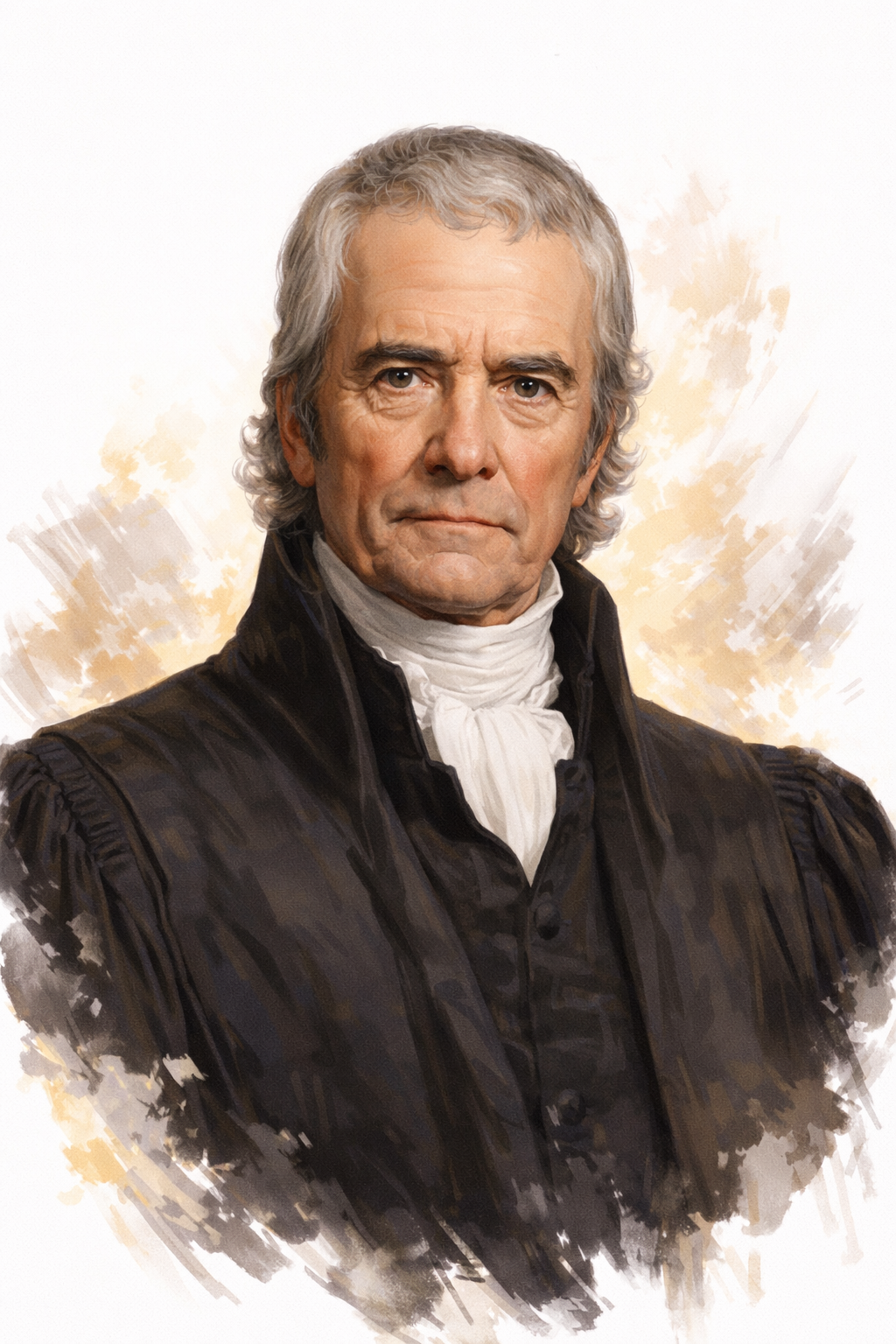
John Marshall
Details
- Birth
- September 24, 1755 · Germantown, Virginia
- Death
- July 6, 1835
- Law school
- william and mary, college of
- Prior experience
- Various legal and public service prior to appointment
Biography
John Marshall (1755-1835) served as the fourth Chief Justice of the United States Supreme Court from 1801 to 1835, becoming one of the most influential figures in American constitutional law. Born in a log cabin in Germantown, Virginia, Marshall received limited formal education but studied law under George Wythe at the College of William & Mary. He served as a captain in the Continental Army during the Revolutionary War and later established a successful law practice in Richmond. Marshall entered politics as a Federalist, serving in the Virginia House of Delegates, as a diplomat to France, and briefly as Secretary of State under President John Adams before his appointment to the Supreme Court. As Chief Justice, Marshall established the principle of judicial review and significantly strengthened federal power through his constitutional interpretations. His judicial philosophy emphasized a strong national government and broad interpretation of federal authority. Among his most significant opinions, *Marbury v. Madison* (1803) established the Supreme Court's power to declare laws unconstitutional, while *McCulloch v. Maryland* (1819) affirmed the federal government's implied powers and supremacy over state law. *Gibbons v. Ogden* (1824) broadly interpreted the Commerce Clause, expanding federal regulatory authority. Marshall's decisions consistently favored federal power over states' rights and protected property rights and contracts from state interference. His 34-year tenure transformed the Supreme Court from a weak institution into a co-equal branch of government, establishing enduring precedents that shaped American constitutional law and the balance of federalism for generations.
Notable opinions
- Marbury v. Madison
- McCulloch v. Maryland
- Gibbons v. Ogden