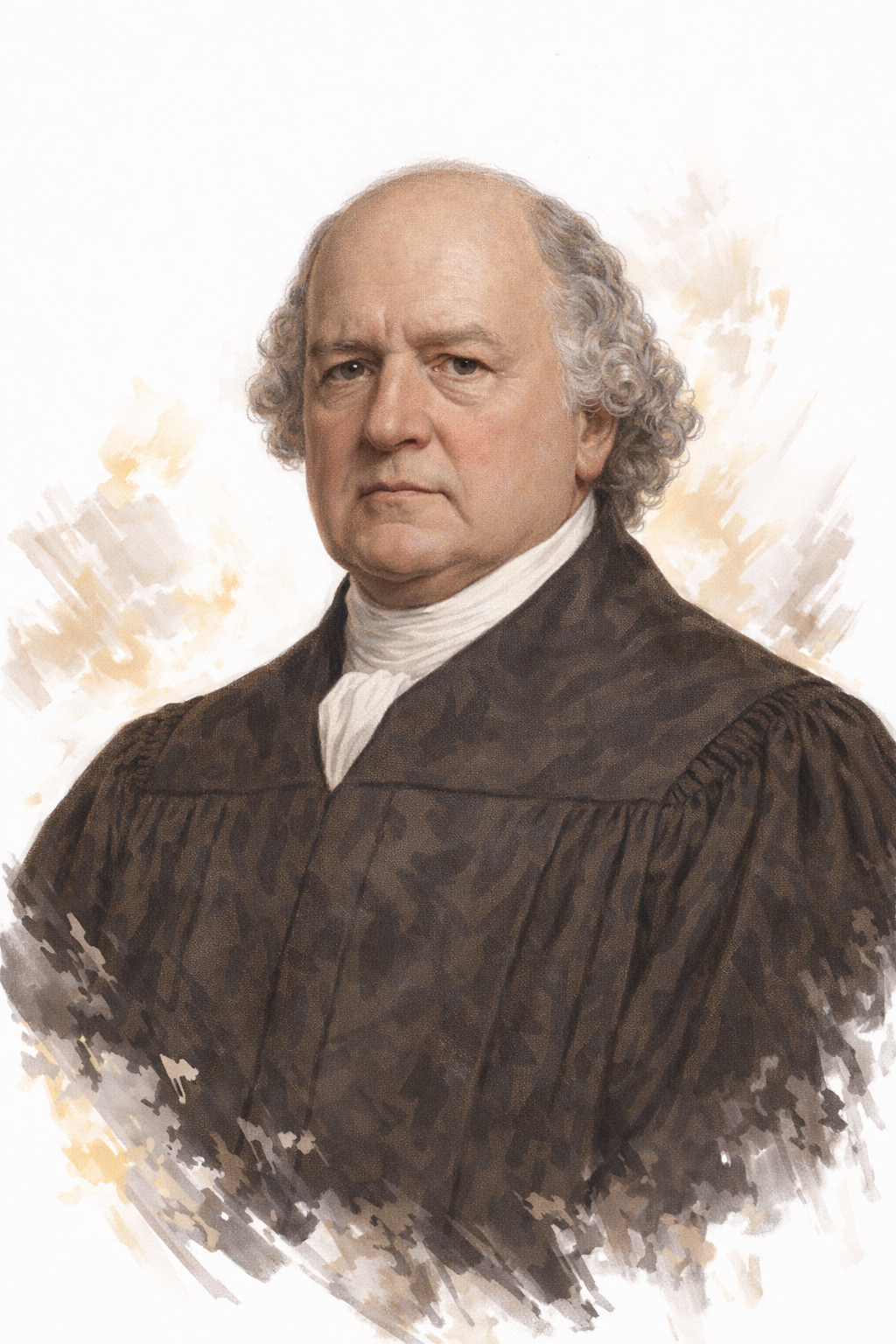
Samuel Chase
Details
- Birth
- April 17, 1741 · Somerset County, Maryland
- Death
- June 19, 1811
- Law school
- Read law (Hall, John)
- Prior experience
- State trial court judge
Biography
Samuel Chase (1741–1811) was an Associate Justice of the United States Supreme Court from 1796 to 1811 and a signer of the Declaration of Independence. Born in Somerset County, Maryland, Chase received his early education from his father, Reverend Thomas Chase, before studying law and gaining admission to the Maryland bar in 1761. He quickly established himself as a prominent lawyer and politician, serving in the Maryland General Assembly and the Continental Congress. Chase was known for his fiery temperament and strong Federalist views, earning him the nickname "Old Bacon Face" for his ruddy complexion and volatile demeanor. President George Washington appointed Chase to the Supreme Court in 1796, where he became known for his partisan approach to jurisprudence and his strong support for federal authority. His judicial philosophy emphasized broad construction of federal powers and strict enforcement of federal law. Chase's tenure was marked by controversy, particularly his conduct during sedition trials in the early 1800s, where his harsh treatment of defendants and partisan jury instructions drew widespread criticism. His most significant contribution came in *Fletcher v. Peck* (1810), where he joined the majority in establishing important precedents regarding contract rights and state sovereignty. Chase holds the distinction of being the only Supreme Court Justice ever impeached by the House of Representatives, in 1804, following accusations of political bias and judicial misconduct. However, he was acquitted by the Senate in 1805, with the proceedings establishing important precedents about judicial independence and the separation of powers. His acquittal helped solidify the principle that federal judges should not be removed for political reasons alone, but only for serious criminal conduct. Chase continued serving on the Court until his death in 1811, leaving a complex legacy as both a founding father and a controversial jurist.
Notable opinions
- United States v. Callender
- Ex parte Bollman