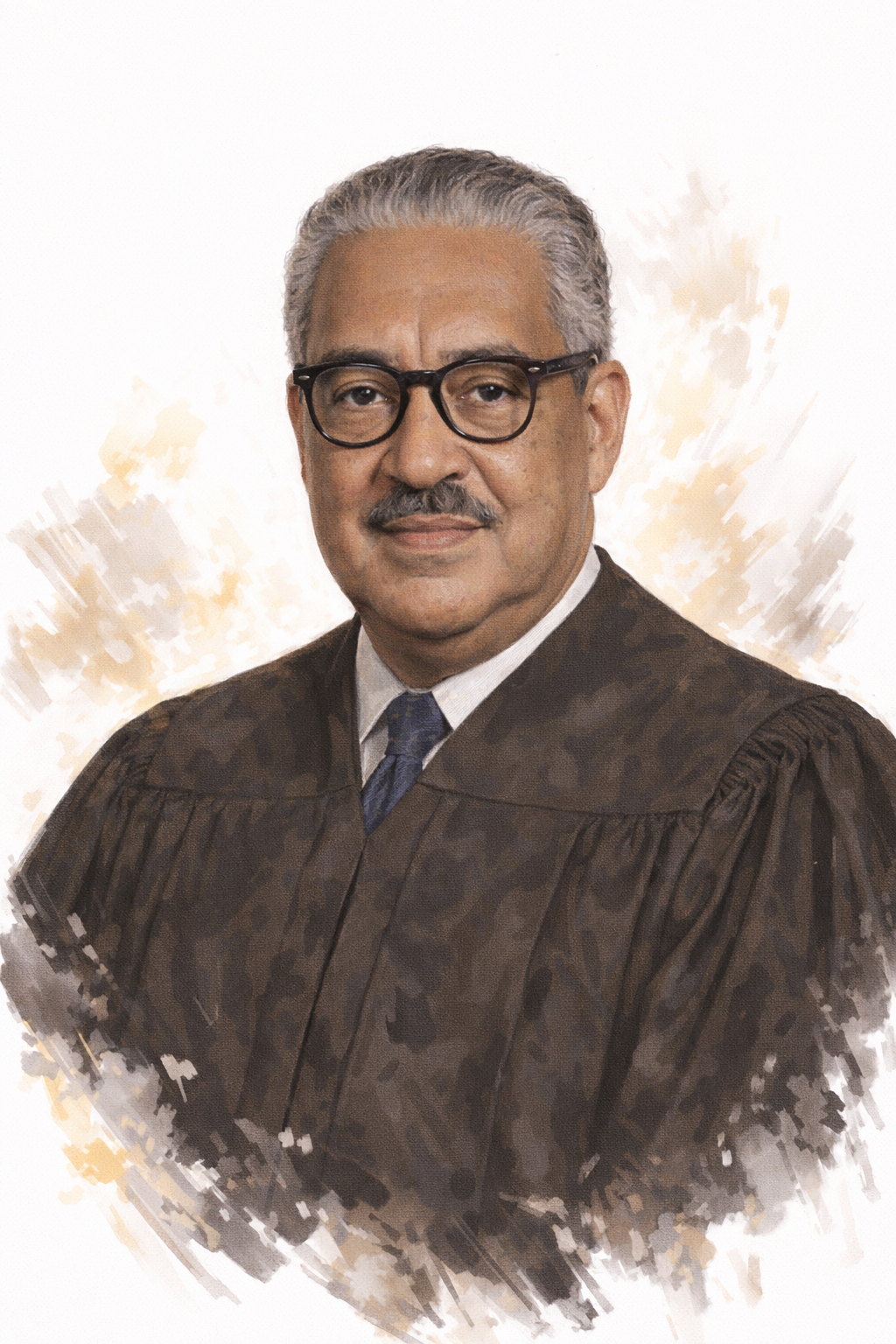
Thurgood Marshall
Details
- Birth
- July 2, 1908 · Baltimore, Maryland
- Death
- January 24, 1993
- Law school
- howard university
- Prior experience
- Various legal and public service prior to appointment
Biography
Thurgood Marshall (1908-1993) was an Associate Justice of the United States Supreme Court from 1967 to 1991, serving as the first African American justice in the Court's history. Born in Baltimore, Maryland, Marshall earned his law degree from Howard University Law School in 1933, where he was mentored by Charles Hamilton Houston. After practicing law privately, he joined the NAACP Legal Defense and Educational Fund in 1940, eventually becoming its chief counsel. In this role, Marshall argued 32 cases before the Supreme Court, winning 29, including the landmark Brown v. Board of Education (1954), which declared racial segregation in public schools unconstitutional. President John F. Kennedy appointed him to the United States Court of Appeals for the Second Circuit in 1961, and President Lyndon B. Johnson nominated him to the Supreme Court in 1967. As a Supreme Court justice, Marshall maintained a liberal judicial philosophy, consistently supporting civil rights, criminal defendants' rights, and individual liberties. He was a strong advocate for the application of the Bill of Rights to state governments and opposed capital punishment throughout his tenure. Marshall's most significant opinions included his dissent in Milliken v. Bradley (1974), where he criticized the majority's limitation on school desegregation remedies, and his opinion in Bounds v. Smith (1977), which established prisoners' rights to adequate law libraries. His legacy extends far beyond his judicial service; Marshall's work as a civil rights lawyer fundamentally transformed American constitutional law and helped dismantle legal segregation. He retired from the Court in 1991 due to declining health and died in 1993, remembered as one of the most influential legal figures of the twentieth century.
Notable opinions
- Brown v. Board of Education
- Furman v. Georgia
- Regents of the University of California v. Bakke