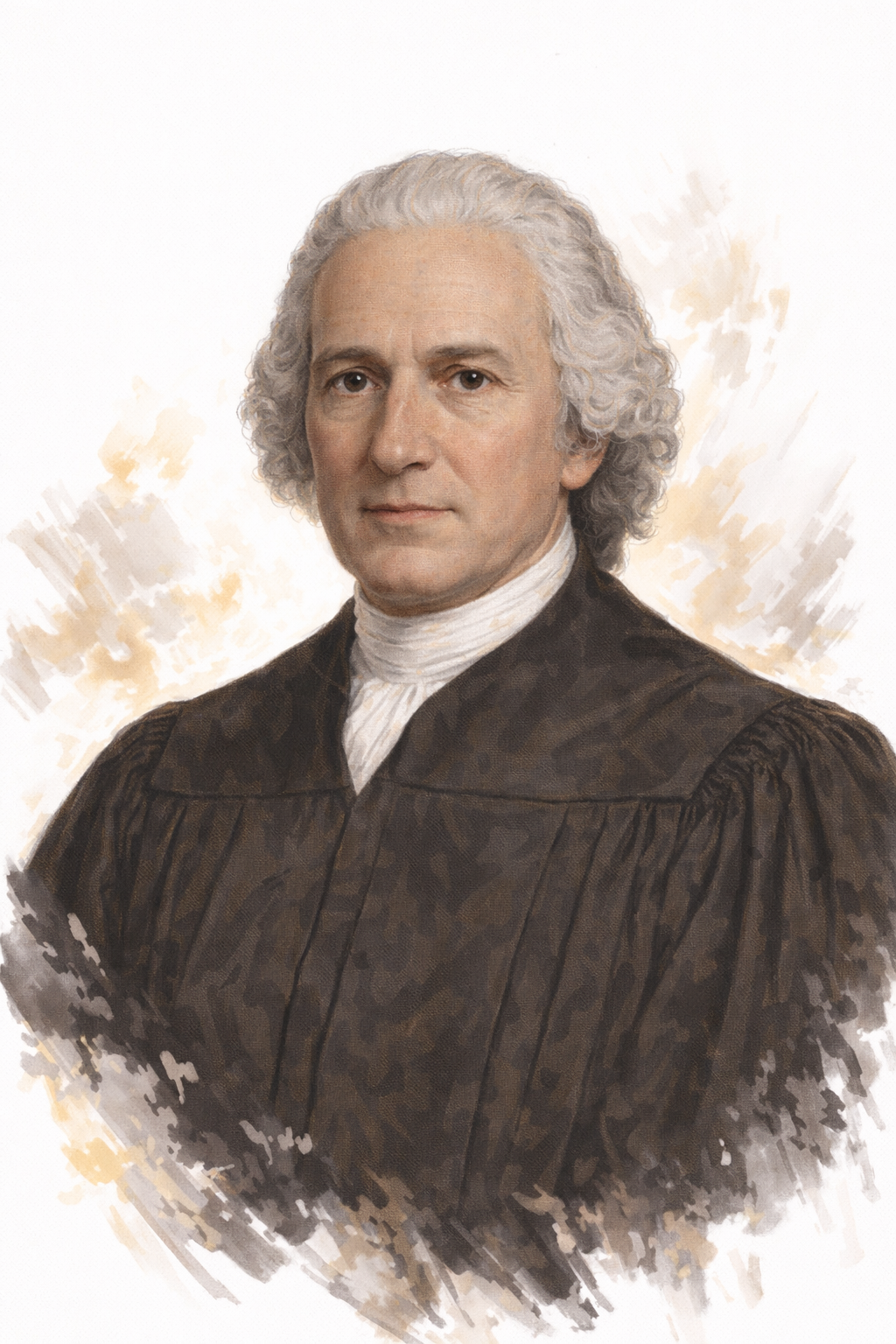
William Paterson
Details
- Birth
- December 24, 1745 · County Antrim, Ireland
- Death
- September 9, 1806
- Law school
- princeton university; read law (Stockton, Richard)
- Prior experience
- Various legal and public service prior to appointment
Biography
William Paterson (December 24, 1745 – September 9, 1806) was an Associate Justice of the United States Supreme Court from 1793 to 1806. Born in County Antrim, Ireland, Paterson immigrated to America as a child with his family, settling in New Jersey. He graduated from the College of New Jersey (now Princeton University) in 1763 and studied law, gaining admission to the New Jersey bar in 1768. Paterson served as New Jersey's attorney general from 1776 to 1783 and was a delegate to the Constitutional Convention of 1787, where he proposed the "New Jersey Plan" advocating for equal state representation in Congress. He subsequently served as one of New Jersey's first U.S. senators from 1789 to 1790 and as the state's governor from 1790 to 1793. President George Washington nominated Paterson to the Supreme Court in 1793, where he served until his death in 1806. As a Federalist, Paterson generally supported a strong federal government and broad interpretation of federal powers, though he was considered more moderate than some of his contemporaries. His most significant opinion came in *Hylton v. United States* (1796), where the Court upheld the constitutionality of a federal tax on carriages, establishing important precedent regarding direct versus indirect taxation. Paterson also participated in several early circuit court cases that helped define federal judicial authority. His legacy extends beyond the Supreme Court through his drafting of the Judiciary Act of 1789 while serving as a senator, which established the federal court system's structure. Paterson, New Jersey, and Paterson University are named in his honor, reflecting his lasting contribution to American jurisprudence and constitutional development.
Notable opinions
- Vanhorne's Lessee v. Dorrance
- Hylton v. United States